
 中文简体
中文简体

Product Consultation
Your email address will not be published. Required fields are marked *
Content
Yes — nitrile gloves are food safe when they are labeled and manufactured specifically for food contact. Food-grade nitrile gloves are made without latex proteins and with controlled levels of chemical accelerators, making them a reliable barrier between hands and food during preparation, handling, and service. However, not every pair of nitrile gloves on the market qualifies. The key lies in the formulation, the manufacturing process, and the intended-use designation printed on the box.
This article walks through exactly what makes nitrile gloves safe for food use, how they compare to other glove types, what to look for when buying, and how different industries rely on them every day.
Nitrile is a synthetic rubber — specifically acrylonitrile butadiene rubber — that does not contain natural latex proteins. This is important because latex proteins can transfer to food and trigger allergic reactions in sensitive individuals. Nitrile eliminates that concern entirely.
For a nitrile glove to be considered food safe, several factors must be true simultaneously:
Most reputable manufacturers produce specific product lines designated for food service, and those products carry explicit labeling confirming food contact suitability. A general-purpose nitrile glove sold for automotive or industrial work is a different product even if it looks identical.
Food handlers have three common disposable glove options. Each has a distinct profile of strengths and weaknesses when used in a food environment.
| Property | Nitrile Gloves | Latex Gloves | Vinyl Gloves |
|---|---|---|---|
| Allergen risk | None (latex-free) | High (latex proteins) | None |
| Puncture resistance | Excellent | Good | Poor |
| Chemical resistance | Excellent | Moderate | Low |
| Tactile sensitivity | Very good | Very good | Fair |
| Fit and comfort | Excellent | Excellent | Moderate |
| Cost | Moderate to high | Moderate | Low |
| Suitable for raw meat | Yes | Yes (if no allergy present) | Marginal |
Nitrile gloves consistently outperform the alternatives in environments where the gloves may come into contact with acidic marinades, fats, citrus juice, or cleaning chemicals between tasks. Vinyl gloves, while inexpensive, have a looser molecular structure that allows certain chemicals and microorganisms to pass through more easily over time — a meaningful risk in a busy kitchen.
For raw meat processing in particular, nitrile gloves are the preferred choice among food safety professionals because the material resists tearing even under the mechanical stress of butchering, deboning, or packing.
Nitrile gloves are measured in mils (thousandths of an inch). Food service nitrile gloves typically fall into one of three thickness categories, and each serves a different purpose:
These are the thinnest commonly available food-grade nitrile gloves. They offer excellent tactile sensitivity, making them popular for tasks like plating, garnishing, assembling sandwiches, or handling baked goods. Because they are thin, they are less durable under abrasion or prolonged use, and should be changed more frequently in high-contact tasks.
This is the most common thickness range for restaurant and catering work. A 5-mil nitrile glove provides a good balance between dexterity and durability, lasting through extended food prep sessions without frequent replacement. Most commercially produced boxes of food-service nitrile gloves fall into this range.
Thicker gloves are used in meat processing facilities, fish cleaning, or any environment where the gloves are subjected to sharp tools, prolonged wet conditions, or high friction. An 8-mil glove significantly reduces the risk of puncture, which is critical when processing raw protein. Some facilities use gloves in the 10–15 mil range for extended shifts on processing lines.
The takeaway: thicker is not always better. Choosing a glove that is too thick for a task reduces the worker's feel for fine motor work, increasing the chance of dropping items or making mistakes that could themselves create food safety issues.
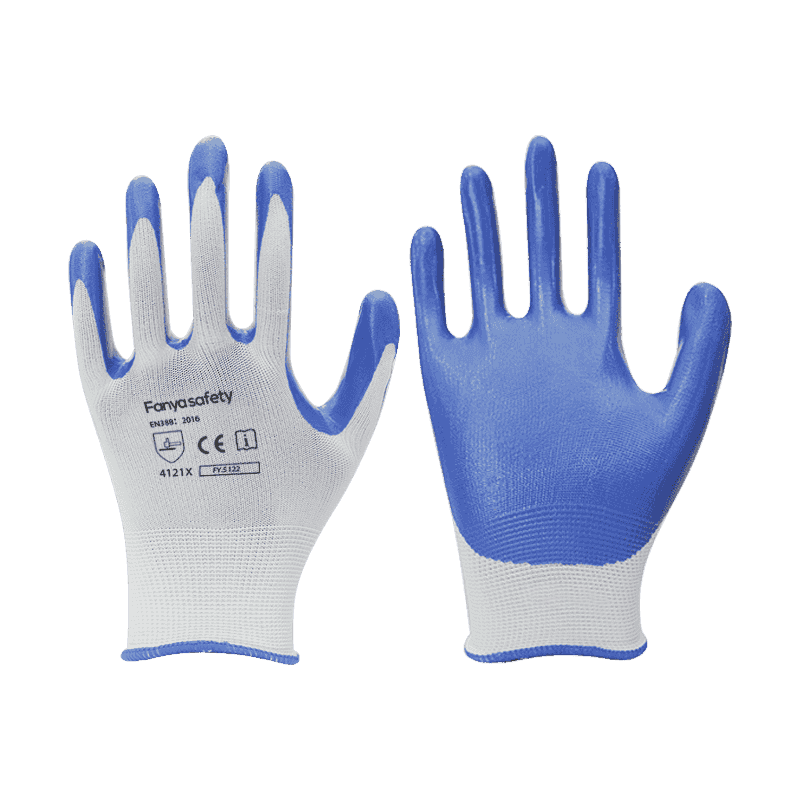
Walk into any commercial kitchen or food processing plant and you will likely see bright blue nitrile gloves. This is not accidental. Blue is used specifically because it is a color that does not naturally occur in most food products. If a glove — or a fragment of one — falls into a batch of food, the blue color makes it immediately visible against most food backgrounds: pale doughs, red meat, green vegetables, beige sauces.
Some facilities extend this logic into full color-coding programs:
This kind of visual management reduces cross-contamination risk at a glance, without requiring workers to read labels during a busy shift. For food manufacturers who run metal detection or X-ray inspection on finished products, some companies even produce nitrile gloves with metal-detectable or X-ray-detectable additives embedded in the material.
One of the most significant reasons food facilities switched away from latex to nitrile gloves over the past two decades is allergen management — specifically protecting both workers and consumers from latex-related reactions.
Natural rubber latex contains proteins (primarily Hev b proteins) that can cause reactions ranging from contact dermatitis to severe systemic responses in sensitive individuals. When latex gloves are used during food preparation, these proteins can transfer to the food surface. A consumer with a latex sensitivity who eats food prepared with latex gloves may experience a reaction without ever directly touching latex.
Nitrile, being a fully synthetic material, contains no natural rubber proteins. This makes nitrile gloves the appropriate choice for any food business serving customers with unknown allergy profiles — which is essentially every food business.
Beyond latex, some nitrile gloves contain chemical accelerators used in the vulcanization process, such as thiurams or dithiocarbamates. These can cause Type IV (delayed) allergic reactions in some workers. Accelerator-free nitrile gloves have been developed specifically for this population, using alternative curing chemistry that achieves the same physical performance without the sensitizing chemicals. In a food production environment where workers wear gloves for 6–8 hours per shift, this distinction matters considerably for workforce wellbeing and reduced turnover.
Food-safe nitrile gloves are used across a remarkably wide range of environments. Understanding where and how different sectors use them gives a clearer picture of their versatility.
Restaurant kitchens use nitrile gloves primarily during cold prep — breaking down raw proteins, assembling salads, handling ready-to-eat foods. Wearing gloves when handling ready-to-eat foods is a critical control point because these foods will not be cooked before being served, so any contamination introduced during handling stays in the final product. Nitrile gloves provide a barrier that prevents skin-to-food transfer of bacteria, oils, and other contaminants.
Large-scale meat processing facilities are among the heaviest users of food-grade nitrile gloves. Workers on deboning lines, trimming stations, and packing lines may go through multiple pairs per shift. In these environments, cut-resistant nitrile gloves or nitrile over-gloves worn over cut-resistant liners are common, giving both food safety and worker protection from knives and saw blades.
Thin 3–4 mil nitrile gloves are common in bakery environments for handling finished pastries, decorating cakes, or packing items that will not undergo any further heating. The tactile sensitivity of thin nitrile allows decorators to work with fine piping detail while maintaining the necessary hygiene barrier.
Fish processing environments are demanding: cold temperatures, wet surfaces, sharp bones, and constant moisture all degrade gloves faster than in dry environments. Medium-to-thick food-grade nitrile gloves are preferred here because they resist the oils in fish, maintain integrity in cold water, and can be easily changed between species to prevent cross-flavor contamination in high-end processing.
Supermarket delis, prepared-food counters, and sandwich shops use food-grade nitrile gloves continuously through the workday. A key practice here is changing gloves between different food categories — after handling raw meat, before touching bread or cheese — to prevent cross-contamination within the same work area.
In food manufacturing plants, workers on filling lines, inspection stations, and manual packaging lines wear nitrile gloves throughout their shifts. These environments often require gloves in specific colors to match quality control programs, and gloves may need to meet specific extractable content thresholds to comply with the facility's internal food safety plan.
Wearing gloves is only effective when the practice is paired with correct technique. Improperly used gloves can actually increase contamination risk compared to bare, well-washed hands in some scenarios.
Training staff on these steps is as important as purchasing the right gloves. In studies of food handling practices, incorrect glove use was identified as a contributing factor in a significant portion of food contamination events linked to gloved workers — meaning the gloves were present but not used in a manner that prevented the contamination.
Food-grade nitrile gloves have a shelf life — typically 3 to 5 years from the date of manufacture when stored correctly. Improper storage accelerates degradation and can render a glove physically compromised before it reaches the end-user.
Conditions that degrade nitrile gloves over time include:
The recommended storage environment for food-grade nitrile gloves is a cool, dry, dark location with temperatures between 10°C and 25°C (50°F–77°F) and relative humidity below 65%. Original packaging should be kept intact until the gloves are needed, as the box provides meaningful protection against light and particulate contamination.
In a busy food service context, it is worth establishing a first-in-first-out (FIFO) system for glove stock rotation — exactly the same principle applied to food ingredients. Older boxes are moved to the front of the storage area and used before newer deliveries.
For food applications, powder-free nitrile gloves are the only appropriate choice. Powdered gloves use cornstarch as a donning lubricant to make putting the gloves on easier, particularly when hands are slightly damp. However, this powder creates several problems in food environments:
Powder-free nitrile gloves are manufactured using a chlorination or polymer coating process to achieve easy donning without additives. The inner surface of the glove is treated during production so it releases from the hand smoothly. In professional food settings, powder-free is the standard, not the exception, and most food-grade product lines from reputable manufacturers are powder-free by default.
Disposable nitrile gloves are not designed to be reused in food settings. Once removed, the exterior surface of the glove has been contaminated with bacteria or food residue from the previous task, and re-donning the same glove risks transferring that contamination to the wearer's hand and then to the next food item handled. Some thicker, reusable nitrile gloves exist for utility purposes, but these are designed for non-food industrial work and require thorough cleaning protocols that are impractical in a kitchen. In food service, single use is the standard.
High-quality food-grade nitrile gloves do not impart any taste or odor to food under normal handling conditions. However, lower-quality gloves with higher residual chemical content or strong manufacturing odors can occasionally affect delicate flavor profiles — particularly in tasks like handling raw fish, chocolate, or fresh herbs where off-odors are easily detected. Sourcing gloves from reputable food-service suppliers with documented food-contact suitability eliminates this concern in practice.
Black nitrile gloves can be food safe if the colorant used is approved for food contact and the overall formulation meets food-grade requirements. However, black is not the preferred color for food settings because fragments of black gloves are extremely difficult to detect visually against most food products and on most work surfaces. For food applications, blue remains the preferred choice because it maximizes visibility. Black nitrile gloves are more commonly associated with automotive work, tattoo studios, and janitorial services.
There is no fixed time interval for glove changes that applies universally. Gloves should be changed whenever the task changes (e.g., from raw meat to ready-to-eat foods), whenever the glove is visibly soiled or torn, whenever a non-food surface is touched, and any time the integrity of the glove may have been compromised. In high-volume operations, workers may go through 10 to 20 pairs of nitrile gloves per shift, especially at raw protein stations. This high consumption rate is intentional and budgeted for as part of food safety compliance costs.
Nitrile gloves provide minimal insulation against heat. They are suitable for handling warm foods under approximately 60°C (140°F) briefly, but they do not protect against burns from hot pans, steam, or prolonged contact with hot surfaces. For oven work or handling hot equipment, heat-rated oven mitts or appropriate thermal gloves are the correct protection. Nitrile gloves are designed for hygiene and chemical resistance, not thermal protection.
Nitrile gloves are a well-established, highly effective tool for maintaining food safety across the full range of food handling and production environments. Their latex-free composition eliminates allergen transfer concerns, their chemical resistance makes them durable under realistic kitchen conditions, and their availability in food-grade formulations means there is a suitable product for virtually every application — from delicate pastry work to high-volume raw meat processing.
The critical factors are: purchase gloves explicitly designated for food contact, choose powder-free products without exception, match thickness to the task, and train everyone who uses them on proper glove use protocols. Nitrile gloves are a solution to a real food safety challenge, but only when they are used correctly and consistently.
For any food business, from a single-person catering operation to an industrial food plant, investing in quality food-grade nitrile gloves is one of the most straightforward and cost-effective food safety decisions available. The cost per glove is measured in cents; the cost of a contamination event is measured in far larger terms.
Non Latex Gloves: Best Alternatives to Latex Gloves for Allergies
Latex Gloves Free: Best Latex-Free Glove Types & Buying Guide
Your email address will not be published. Required fields are marked *
You can contact to me using this form.